Jan 15, 2026The Hidden Costs of Global Trade: Building Sustainable and Resilient Supply Chains
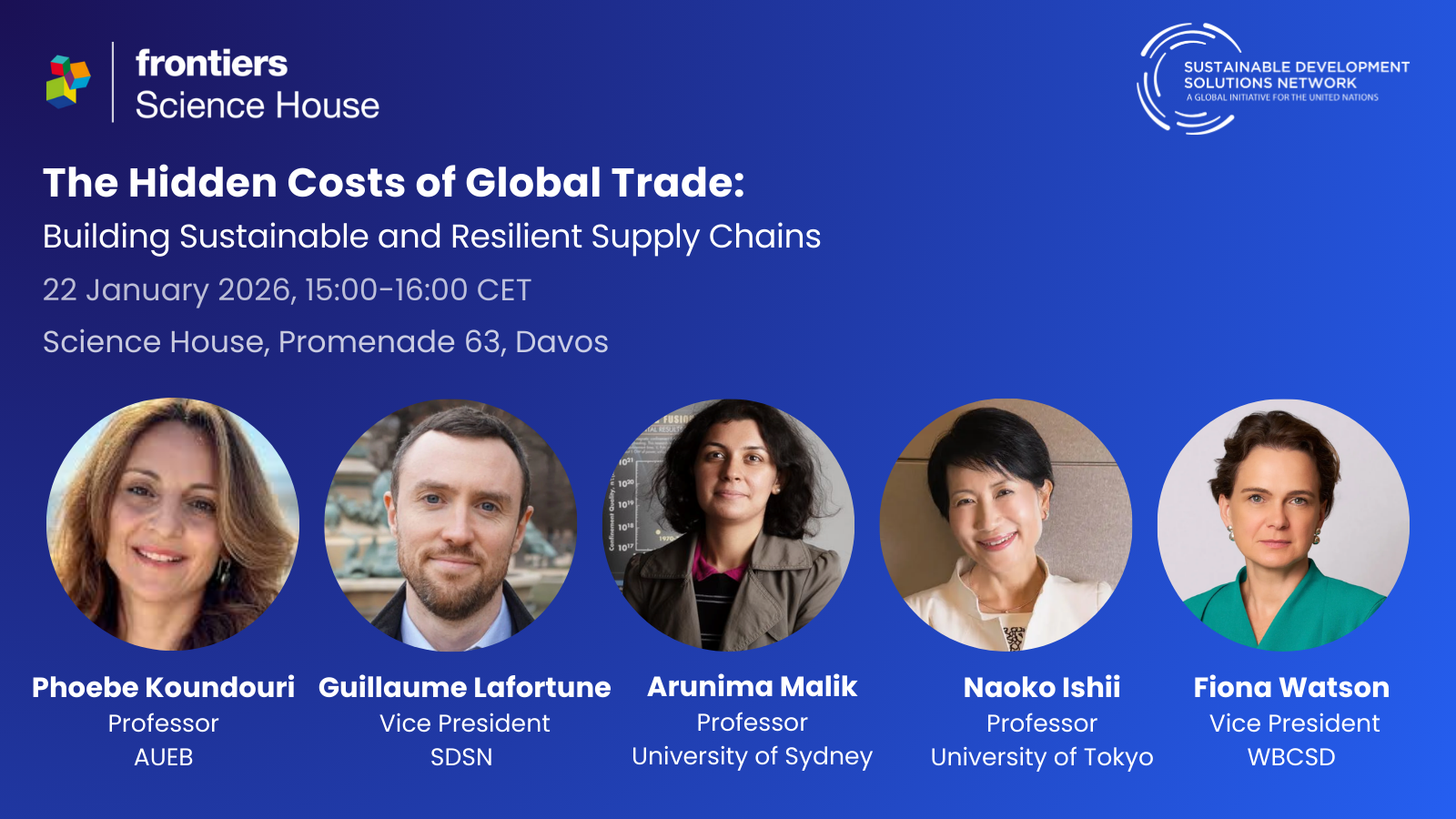
22 January 2026, 15:00 - 16:00 CET
Venue: Frontiers Science House, Hotel Europe, Promenade 63, Davos, Switzerland
On 22 January 2026, the UN Sustainable Development Solutions Network will host a workshop on the Hidden Costs of Global Trade: Building Sustainable and Resilient Supply Chains at Frontiers Science House, during the Annual Meeting of the World Economic Forum.
Background
Global supply chains are the backbone of international trade, yet they are increasingly vulnerable to geopolitical tensions, climate risks, natural disasters, regulatory uncertainty, and economic fluctuations. Recent crises - from the COVID-19 pandemic to climate-related disasters and rising geopolitical instability - have highlighted how disruptions in supply chains can cascade across the global economy.
Beyond their role in trade and economic growth, global supply chains are powerful determinants of environmental, social, and economic outcomes worldwide. From raw material extraction to manufacturing and logistics, supply chains generate significant spillover effects, including greenhouse gas emissions, resource depletion, biodiversity loss, labor exploitation, and social inequities. These impacts often occur far from the point of consumption, disproportionately affecting communities and ecosystems in emerging and developing countries.
In today’s uncertain world, understanding and measuring these impacts is critical for building sustainable and resilient supply chains. By quantifying environmental, social, and economic spillovers, governments and businesses can identify vulnerabilities, anticipate risks, and prioritize interventions to reduce exposure to shocks. Systematic assessment of supply chain impacts enables trade networks to be designed in ways that mitigate environmental harm, improve social outcomes, enhance global resilience, and boost competitiveness.
The session will examine key global trade and governance reforms needed to enhance the sustainability and resilience of global supply chains, while exploring the role of governments in addressing systemic vulnerabilities and negative externalities. It will also demonstrate how science-based tools and robust data systems for measuring trade impacts can help minimize exposure to risks and shocks and build supply chains and trade systems aligned with the Sustainable Development Goals.
The session will feature:
-
Guillaume Lafortune, Vice President, UN Sustainable Development Solutions Network
-
Phoebe Koundouri, Professor at the University of Economics and Business, Greece & Technical University of Denmark, Director of AE4RIA, Co-Chair, SDSN Europe
-
Fiona Watson, Vice President for Corporate Performance and Accountability, World Business Council for Sustainable Development
-
Naoko Ishii, Professor and Director, Center for Global Commons, the University of Tokyo
-
Arunima Malik, Professor in Sustainability, The University of Sydney, and the International Champion of the 2025 Frontiers Planet Prize
If you are in Davos, join us at Frontiers Science House via this registration link